

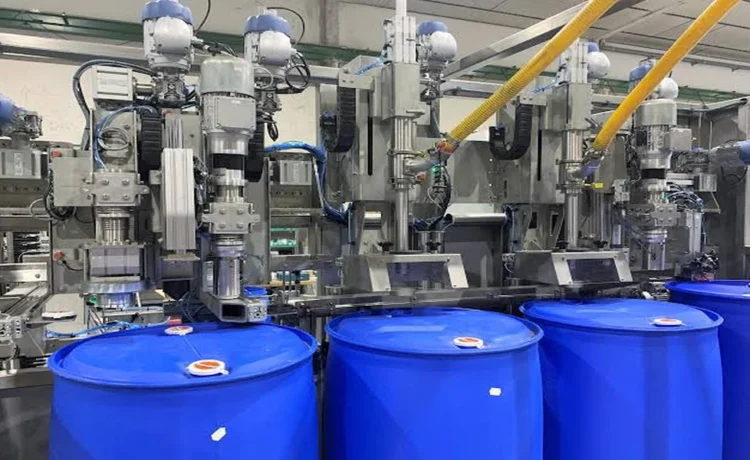
A two-hundred-litre drum full of product weighs more than most people can safely move, cannot be lifted onto a scale by hand, and holds enough value that a one percent filling error is worth noticing. Everything about handling this format is heavier and less forgiving than pails or cans, which is why drum filling tends to be automated earlier than smaller container formats in most plants.
The Weight Problem Comes First
A filled steel drum is heavy enough that manual handling is not really an option beyond rolling it a short distance on its rim. Positioning an empty drum, filling it, closing it and moving it away all involve equipment, pallet trucks, drum handlers, roller conveyors or turntables. Any filling system has to be designed around how drums arrive and leave, and the handling is frequently a larger part of the project than the filling head itself.
Bung Filling and Open Head
Two drum types impose different approaches. Closed-head drums have a bung opening, typically a small threaded aperture, which constrains fill rate and requires an accurately positioned lance. Open-head drums with a removable lid allow a wider filling path and easier cleaning but need the lid placed and secured after filling. Bung drums also need the opening located, which on an automatic line means either consistent presentation or a detection system that finds it.
Filling by Weight Is Usually Correct
Because drums hold large volumes, small percentage errors represent significant quantities. Weigh filling using a platform scale under the drum, filling to a target mass, compensates automatically for density changes with temperature and between batches. It also produces a record for each drum, which supports the traceability requirements common in chemical and lubricant supply. Volumetric filling is workable, but for this format the weigh-based approach is generally more accurate and easier to defend to a customer.
Two-Stage Filling and Splash Control
Filling a drum quickly through a small bung opening produces splashing, aeration and, with solvent products, vapour release. The standard solution is a lance that descends into the drum and fills from below the rising surface, combined with a fast bulk fill followed by a slow dribble to approach the target accurately. The lance retracts as the level rises and drains before withdrawal, so it does not drip across the drum top or the floor.
Vapour, Static and Hazardous Areas
Many drummed products are solvents or flammable liquids, which brings the whole hazardous area regime into scope. Equipment within the classified zone must be suitable for the atmosphere. Bonding and earthing between the lance, the drum and the structure are essential to dissipate static generated by flowing liquid, since this is a recognised ignition mechanism. Vapour extraction at the fill point protects operators and reduces the classified zone. All of this is specified at the outset or not at all.
Handling Around the Filling Station
An automatic installation typically includes roller conveyors bringing empty drums in, a positioning and clamping arrangement, the weigh platform, the filling lance, bung closing or lid placement, and a discharge conveyor. Where output is high, drums move onto a palletiser rather than being handled individually. Suppliers of drum handling and palletising equipment should be quoting the complete sequence, since a filling head with manual handling either side changes very little.
Cleaning and Product Changeover
Lances, hoses and pumps retain product, and where a plant runs multiple grades the changeover regime determines usable capacity. Ask how the wetted path is drained, whether it can be flushed in place, how much product is lost per changeover, and how long the process takes. For a lubricants blender running many grades in modest batches, changeover time and product loss frequently dominate the economics far more than filling speed does.
Intermediate Bulk Containers Alongside Drums
Many plants fill both drums and IBCs, and the two formats share a station awkwardly. An IBC holds around a thousand litres, sits on an integral pallet and has a top fill opening at a different height from a drum bung. Filling one takes considerably longer, which changes how the line schedules, and the weigh platform has to be rated for the greater mass. Some installations handle both with a height-adjustable lance and a platform sized for the larger container; others separate the two entirely. Decide early which your plant needs, because retrofitting IBC capability onto a drum-only station is rarely economical.
Accuracy, Giveaway and Compliance
Where drums are sold by nominal volume or weight, consistent overfilling is a direct and invisible loss. On a high-value specialty chemical the annual figure is substantial. Equally, underfilling creates customer disputes and potential compliance issues where declared quantities apply. A properly calibrated weigh-fill system holds a tolerance that manual filling cannot approach, and the calibration should be checked and recorded on a schedule rather than assumed to hold indefinitely.
Building the Case and Choosing a Supplier
Count the current position: drums per shift, operators involved, average giveaway, spillage, and any manual handling injuries or near misses. Model the same with automation, including installation, commissioning, training and lost production during changeover. Then assess suppliers on hazardous area experience, handling design, changeover provision, local spares and breakdown response. Specified that way, drum filling automation usually justifies itself on accuracy and safety before throughput enters the calculation at all.